
While using artificial fertilizers and pesticides might seem like a harmless practice without any serious implications, it’s one of the most devastating practices whose harm outweighs the benefits. You are putting your family’s life at risk, the environment at risk, and most of all, contributing your part in destroying the ecosystem. And the blame doesn’t lie on you.
It’s quite easy to be manipulated by all those flashy ads with fancy products advertised as the “only elixir” your lawn needs to be alive again. But hey, you already have everything you’ll ever need at home—accessible, safe, and organic.
This article will explore how you can cut through harmful artificial fertilizers and pesticides and grow your grass following safe and organic practices.
Let’s jump in!
Why Organic Lawn Care Could Be Beneficial for You:
The benefits of organic lawn care are multifaceted and extend well beyond just a lush green lawn. Here are some benefits of organic practices that might help you understand how green practices help:
Your soil will be healthier than ever
If there’s one thing you must know about artificial fertilizers, it is that their effects come quick and go quick. What we mean is, you see instant results, but they disappear as quickly. Since organic methods go levels deep in soil and actually nourish it by improving its microbial life and structure, the results you’ll see will be amazing, long-term, and super safe.
You will be saving the environment
Nothing feels better than serving the community, and being environmentally friendly is one way to do it. Organic lawn care means fewer pesticides, which means less pollution, more biodiversity, and a low carbon footprint. While this might not seem like a very direct “benefit”, you’re actually playing your part in saving the generations that are to come with such small practices.
You will be keeping your family safe
Zero pesticides mean zero toxins and a lush, green, beautiful grass-covered lawn where your children and pets can play without having to worry about a thing. Besides, organically grown grass looks much more aesthetically pleasing compared to grass grown artificially, which looks frail, even if it’s green.
It will cost you less
Well, we get it. On the surface, organic lawn care might seem quite expensive. But think long term! You’ll have to care way less for your lawn in the future, and you won’t have to spend a penny on the chemical treatments and fertilizers that make your lawn dependent on them every season. So yup, more upfront payment, but future-proof.
Organic Lawn Care—Your Guide to Making an Eco-friendly Lawn
Now that we’re past the potential benefits of going organic, let’s explore how you can grow chemical-free grass with some tips that will come in handy:
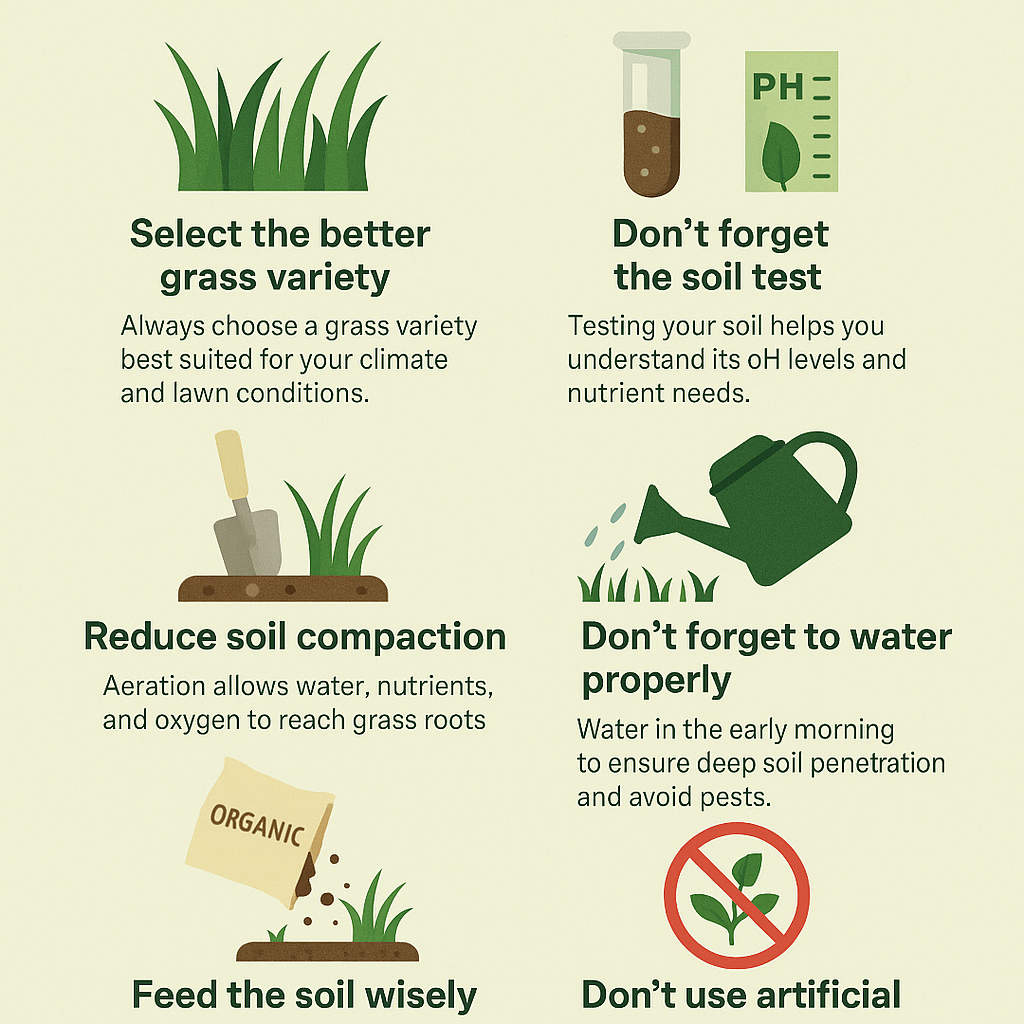
Select the better grass variety
Always choose a grass variety that’s best suited for your climate and lawn conditions. Such grass is more often naturally resistant to pests and diseases. Which means you have to use way fewer pesticides and herbicides, making it a safe and environmentally friendly option. You can also factor in other elements like sun exposure, water availability, and your soil type to even lower down on the maintenance part by choosing the best suited grass type.
Don’t forget the soil test.
You can get the best grass, use the most balanced fertilizer, and do regular maintenance. But if there’s a problem with your soil, all that will be fruitless. Testing your soil can help you avoid that and give you a good idea of its pH levels, which you can study to analyze whether it’s in ideal condition to grow grass. A pH level of 6.5 to 7 is often considered excellent to grow grass, as it provides ample support for the grass roots to absorb more nutrients, giving you fewer headaches.
Reduce soil compaction
Soil particles can compact our time due to various reasons. It could be harsh weather, foot traffic, or just outdoor activities. The point is, it’s hard for water to reach the roots of the grass, resulting in it ending up either dull or, in the worst-case scenario, dead. Aeration helps you avoid that. By removing small cylindrical plugs of the soil or digging holes at least 2-3 inches deep, you ensure that all the water, nutrients, and oxygen reach the grass roots. Doing this every season can do magic for your lawn.
Don’t forget to water properly.
Most of the time, people water their lawn and plants either at nighttime or, worse, daytime. You may ask, if we can’t water at night or day, then what should be the right time? Well, it should be early morning. If you water in the middle of the day, the sun is going to evaporate all the water. Similarly, watering at night means water sitting on your grass all night, attracting pests and diseases. Prolonged watering in the early morning ensures the soil absorbs it fully, with the extra being evaporated by the sunlight during the day.
Feed the soil wisely
Feeding the soil with organic fertilizer offers it a perfect blend of nutrients. That too, with slow release to ensure there are minimal to no risks to your grass, unlike artificial fertilizers. If your lawn is small, you can go for homemade choices like compost, fish emulsion, or bone meal. However, if your lawn is big, this might not be a practical option for obvious reasons. In this case, you can go for bagged organic fertilizer/compost from a reputed brand carrying OCB approval. These will provide the same results without any of the harm carried by artificial fertilizers.
Don’t use artificial weed control.
While natural weeding is labor intensive, it ensures the weeds don’t come back anytime soon. Compare this to herbicides, and the results you get are much more satisfying, long-term, and environmentally safe. As you remove weeds, don’t forget to mulch the soil with organic materials (ideally wood chips) to block sunlight. This will ensure no more weed seeds germinate in the soil, and your lawn looks polished for quite a while.
Conclusion
Organic lawn care is hard compared to artificial options. However, the return you get on your labor is much more long-term, effective, sustainable, and highly environmentally friendly. Yup, the upfront costs might seem a bit daunting, but think about it! You will not be going to buy commercial fertilizers and herbicides every now and then, and you certainly won’t be poisoning your lawn every single time. All you need to do is handle ‘nature’ with ‘nature’ and wait patiently as things take their course. The results will make you more than happy!