
Having hedges in your house is one of the best aesthetic choices you can make to beautify your home. But just like any other green part, your hedges also need some extra care. Overgrown hedges can become unmanageable if left unattended for too long. Which means you’ll be essentially spending extra money on something that you could have easily handled by yourself.
Now if you’re someone who has never handled hedge trimming before and is tired of spending on professionals every single time your garden is overgrown, you’re at the right place. Today, we will be telling you all the best tools and techniques you’ll ever need to trim your hedges, without relying on professional services.
Let’s jump into it!
All the Tools You Would Need for Perfect Hedge Trimming
-
Hedge Trimmers
A hedge trimmer is one of the main tools you’ll need to get on with your hedge trimming project. This tool is used mostly for lighter jobs, and comes in all sizes based on your particular needs. For example, if you have bigger hedges, you would like to get the one with a longer reach. For small hedges, the short-reach hedge trimmer will work just fine. Generally, hedge trimmers are great all-rounders and can be used as hedge cutters for small twigs. However, they are, in no case, an optimal replacement for hedge cutters when it comes to handling bigger branches.
-
Hedge Cutters
A hedge cutter is a heavy-duty tool with large and powerful blades that’s used for cutting highly overgrown hedges with woody and thick branches protruding out. While in most cases just a hedge trimmer would be enough, we usually recommend cutters for handling unusually thick overgrowths, as they are made to handle such tasks.
Not sure which one you need for your hedge cutting? Here’s a tip!
If your hedges overgrown just a little, and the branches are, let’s say, ½ inch thick, then hedge trimmers are perfectly fine for the job, as they are made for making those edges neat and clean. However, if there’s a noticeable overgrowth with some big branches protruding out, let’s say, more than 1 inch thick, then you’ll need a proper, heavy-duty, sharp hedge cutter before you go on shaping your hedges with a trimmer.
-
Pruning Shears
Hedge trimming is a delicate task and at certain areas requires some precise cutting to make the edges look attractive. That’s where the pruning shears come in. Ideal for precision cutting, these will help you reach those difficult spots and cut your hedges in a highly targeted way. Just make sure your shears are high quality and sharp. You don’t want to break those branches.
-
Loppers
A lopper has essentially the same job as a hedge cutter. However, it’s more precise. Which means instead of the mass cutting that the hedge cutter does, loppers allow you to cut individual thick branches for more targeted cutting without straining your hands.
-
Hedge Shears
Not extremely necessary since a hedge trimmer will do the job pretty well. But if you love being in complete control of the whole thing, hedge shears might actually be your best choice. Yes, you’ll have to do more manual work, but the detail and control you get for it could be a good tradeoff. Oh, just make sure the handles are comfortable and ergonomic because you’re going to be using it for a long time.
Some Safety Tips
When working with blades, safety is something non-negotiable, no matter how much of an “expert” you are. We highly recommend wearing protective gear such as gloves, safety goggles, and high-quality footwear to prevent any damage that could be caused to your body by flying debris or any kind of accidental cuts (yup, that happens). If you are using automatic tools like hedge trimmers or cutters for an extended duration, having ear defenders on your side might come in handy as well.
Hedge Cutting Made Easier: Our 5-Step Process for Polished Hedges
-
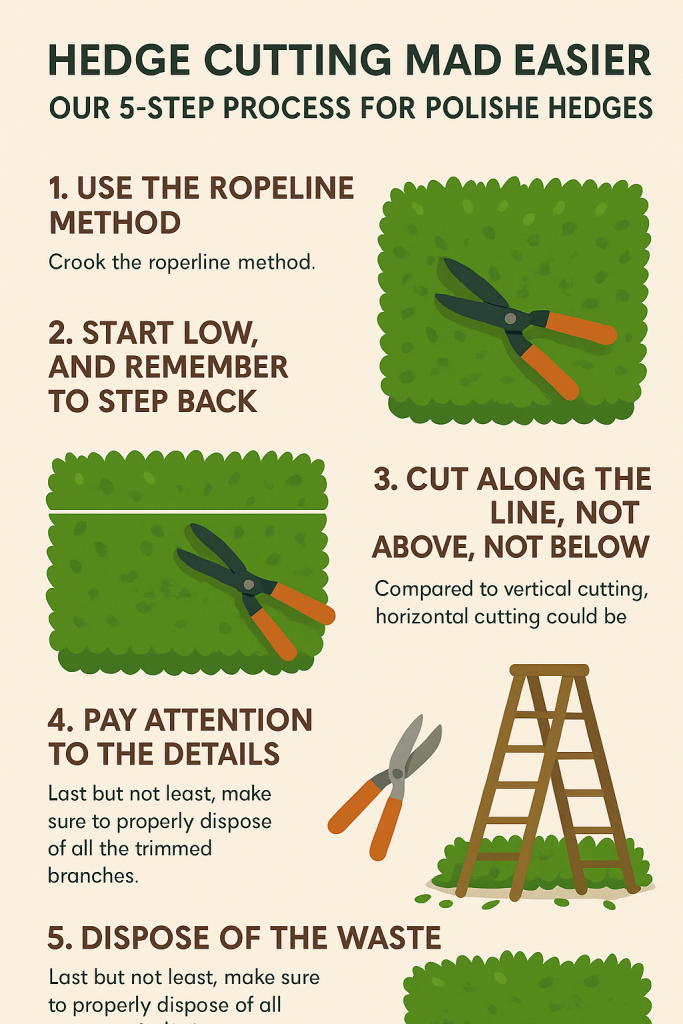 Use the ropeline method.
Crooked tops are the worst when it comes to hedges, as they ruin the whole aesthetic. So before you jump in to cutting and trimming, make sure to stretch a string across the hedge at the exact height you want to cut the hedge. This will make sure the hedge is cut even and straight, ensuring a polished look.
-
Start low, and remember to step back
When cutting vertically, we highly recommend cutting from the bottom and working your way up to the top for a neat finish without any patchy spots. Oh, make sure to take a few steps back every few minutes to see whether the hedge is cut in perfect alignment. Relying on close-up view only can be misleading.
-
Cut along the line, not above, not below
Compared to vertical cutting, horizontal cutting could be very tricky. Just make sure to keep your tool just above the stretched guidance line to ensure even height at every point. If you have a platform or a ladder that helps you reach the top of the hedge, that’s ideal. But if not, getting a pole hedge trimmer would work just fine, allowing you to cut with precision without compromising on safety and accuracy.
-
Pay attention to the details.
Exquisite hedges are not about cutting the long branches. They’re about the tiny details that come after! So as soon as you are done with overgrown parts, get your trimmer and shears and start working on the tiny details for a beautiful finish. This is the most satisfying part of the process, and where you see the fruit of all your efforts.
-
Dispose of the waste.
Last but not least, make sure to properly dispose of all the trimmed branches and leaves. If you have a limb cutter or a chopper, make sure to chop all the materials to either prepare them for the organic waste bin, your compost heap, or transport to the recycling center. In any case, just make sure to get rid of the waste the proper way.
Conclusion
Cutting overgrown hedges can be quite a time-consuming chore. But with the right tools and a set of very basic gardening skills, you can actually deal with it without getting professional help every single time. Just make sure you have some high-quality tools in place, the right set of skills, and of course, all the safety equipment to protect yourself from injuries. With essential tools and following the best practices as described above, trimming your hedge could be quite a satisfying experience, with even more gratifying results once you’re done.